
Manual Trading vs Algo Trading: What’s the Real Difference?
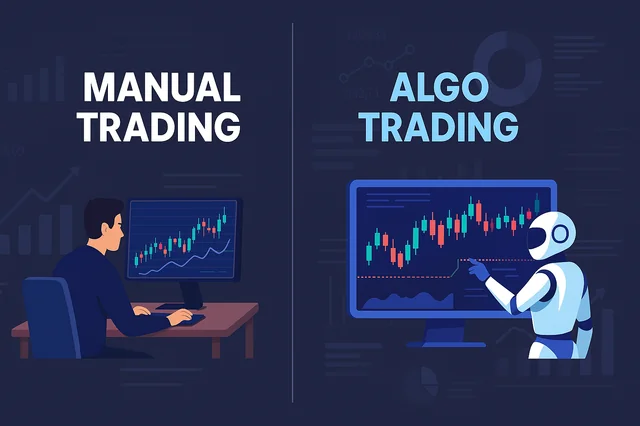
Manual Trading vs Algo Trading: What’s the Real Difference?
 Seo
Seo Today, in every financial market, traders face constant choices between traditional manual trading and fast-evolving algorithmic or algo trading. Both approaches have the objective of generating a profit, but the way they operate, the discipline required, the skills involved, and the trading experience they provide are immensely different. This leads to discussions around Manual Trading vs Algo Trading.
This blog explores the real difference between manual and algo trading.
In this context, understanding Manual Trading vs Algo Trading is essential for making informed trading decisions.
What do you mean by Manual Trading?

Manual trading is the classic approach that has been used by both retail and professional traders for many years. In this method, the trader studies the market, charts, news, patterns, and everything by themselves, then makes the decisions to buy or sell. Every action, from planning a trade to its execution, is performed by the individual using their judgment.
Manual trading, at its very important, brings a human element to the market. A trader’s experience, screen time, patience, and emotional balance shape their decision-making process in unique ways.
This really means that no trade is ever exactly like the last; each move is completely influenced by how the trader interprets the market.
Some traders use technical indicators, others focus on price action, and many blend styles depending on what best fits their market personality.
This is an empowering yet challenging approach. Psychology plays a huge role. For this, greed, fear, hesitation, and overconfidence can affect the outcome of trading just as much as skills and strategy.
A manual trader has to grow, learn, and adapt continuously. In case one enjoys decision-making, personal involvement, and market analysis, manual trading is not without its high value.
How is Algo Trading different compared to other forms?
Algorithmic trading represents a new generation of market participation. Instead of manual decision-making, traders use the computer program-algorithms-that automatically execute trades based on a set of predefined rules.
Such rules may involve prices, statistical influences, technical indicators, or several combinations of more market variables. Once programmed, the software takes over and trades without emotional interference, often much faster than a human possibly could.
Algorithmic trading lets traders backtest their strategy through various market conditions and automate it before taking it live. This inherently brings confidence in the strategy, cuts down on random decision-making, and makes the algos effective in fast-moving markets where milliseconds matter.
Instead of watching charts all day, algo traders focus on refining models, testing new logic, improving strategies, and monitoring system performance. While the trader remains in control, the machine does the heavy lifting. This is where the mindset shifts from “trade executing” to “system developing,” a major departure from traditional manual approaches.
Skills required for Algo and manual trading
Manual traders develop their skill by observing the markets directly. The core of their path will include chart reading, behavioral awareness, pattern recognition, and emotional control. They learn through experience, sometimes in painful ways and sometimes rewarding. Their edge is based on judgment and intuition that develop over hours, months, and years of market observation.
Algo traders think differently. Their value proposition does not stop at being able to analyze market behavior but in transforming the analysis into rules that can be executed by a computer.
It involves programming skills, backtesting procedures, logic, and objective risk management. Algo traders don’t simply ask, “Is this trade a good idea?” They ask, “Can this idea be quantified and executed consistently by a machine?”
Factors to consider while learning algo, and manual trading
One of the very real differences between algo and manual trading is speed. While a human trader may take seconds to click buy or sell, an algorithm will do the same in fractions of a second. In certain markets, that speed is the difference between winning and missing the opportunity altogether.
Other major factors include discipline. Manual trading can fall victim to hesitation, revenge trading, premature exits, and emotional reactions. Algo trading removes such emotional influence. A defined system follows the rules exactly as written: no deviation, no doubt, no fear. The discipline is built into the code.
Consistency is therefore naturally higher in algorithmic trading. While a manual trader may perform on different levels on a good day versus a tired or stressed day, an algorithm will perform identically under the same conditions. This is why professional institutions and hedge funds rely heavily on algorithmic systems.
Potential risk in trading
Both manual and algo trading can be profitable, and both carry risk. The biggest mistake traders make is to think that algo trading guarantees higher returns. It doesn’t. A poorly designed system will fail just as easily as a poorly executed manual strategy.
The deciding factor in success will be in risk management. Manual traders must apply stops, position sizing, and trade planning consciously in real-time. Algo traders must code those protections into their systems ahead of time. A missing rule can lead to disastrous results-especially if the trades are automated.
This market is neutral. It only rewards the prepared, disciplined, and adaptive traders, be it a human or machine-driven approach.
Which trading style is better?
The answer depends solely on the trader.
Manual trading benefits those who:
- Enjoy analyzing markets themselves
- Prefer active decision-making
- Have strong emotional control
- Are comfortable with hands-on participation
Algo trading suits those who:
- Think logically and systematically
- Prefer automation over screen-time
- Enjoy testing and refining ideas
In today’s financial world, both approaches have a place. In fact, most successful traders use hybrid models where they first manually identify high-probability strategies and then automate them over time to maintain consistency.
Conclusion
Manual trading and algo trading are just two paths to the same destination: profitable and consistent involvement in the markets. The distinctions lie in the approach, mindset, development of skills, style of implementation, and personal preference.
Trade4Wealth helps beginners, and experienced traders and investors to learn from basics to advanced training through live mentoring, advanced market learning, and smart trading solutions.