
Why Are Gold & Silver Prices Falling? Where Could the Next Buying Opportunity Emerge?
Why Are Gold & Silver Prices Falling? Where Could the Next Buying Opportunity Emerge?
 admin
Market Analysis | Last updated: 20 November 2026
Gold and silver have come under significant selling pressure, with both precious metals witnessing a sharp correction in domestic and international markets. Gold has moved towards its lowest levels in more than a year, while silver has experienced an even more volatile decline. Understanding why are gold and silver prices falling is crucial for investors. Analyzing why are gold and silver prices falling can help investors make informed decisions.
For investors and traders in India, the immediate question is not simply why prices are falling. It is whether this correction is a temporary reaction to global economic developments or the beginning of a deeper change in the precious metals trend.
Many are asking why are gold and silver prices falling, especially in light of recent market trends. This question is central to understanding the investment climate.
The fluctuations in market prices lead us to consider why are gold and silver prices falling. Investors must pay attention to these changes.
Understanding why are gold and silver prices falling can provide insights into market sentiment and investment strategies.
The recent weakness is closely connected to expectations of further interest rate increases by the US Federal Reserve, a stronger US dollar, elevated Treasury yields and selling pressure across global financial markets. However, the underlying demand and supply conditions for gold and silver tell two different stories.
Investors often wonder why are gold and silver prices falling during times of economic uncertainty.
In this article, we examine the latest market data, the economic factors behind the fall, the global supply-demand outlook, and address the question: Why are gold and silver prices falling? We will also highlight the MCX price levels that traders and investors may want to monitor for potential buying opportunities.
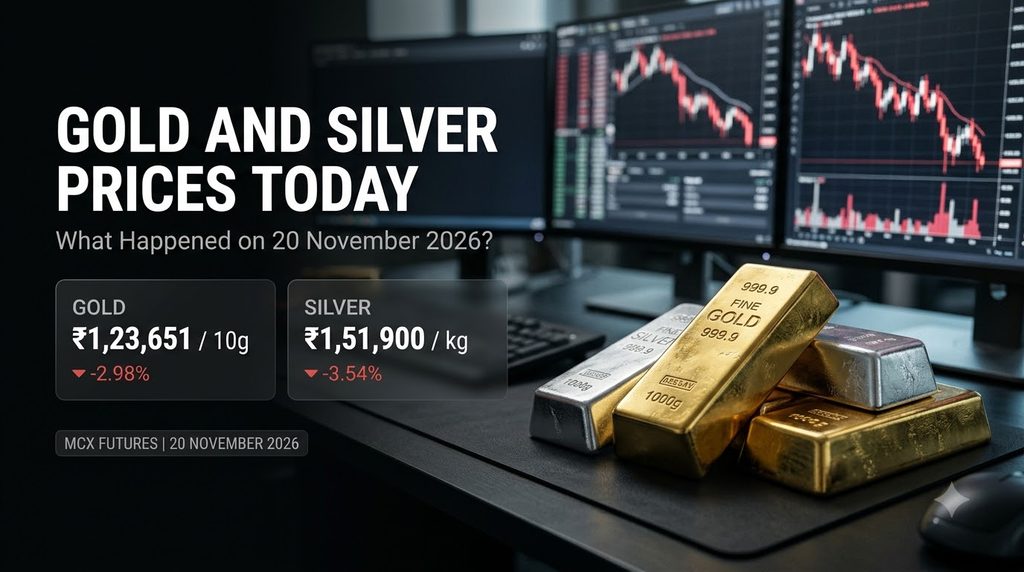
Gold and Silver Prices Today: What Happened on 20 November 2026?
Both precious metals witnessed considerable volatility during Friday’s trading session.
According to market data for the December 4, 2026, MCX futures contracts, gold was trading at approximately ₹1,23,651 per 10 grams at 4:37 PM IST, down 2.98% from its previous close. The contract had touched an intraday low of ₹1,21,424.
The question of why are gold and silver prices falling is on the minds of many as they assess their portfolios.
As we analyze various factors, we must return to the question: why are gold and silver prices falling?
In this context, why are gold and silver prices falling is crucial for formulating investment strategies.
To understand market dynamics, we must ask ourselves why are gold and silver prices falling at such an alarming rate.
Silver futures were trading at approximately ₹1,51,900 per kilogram at 4:49 PM IST, down 3.54% from the previous close. Silver had touched an intraday low of ₹1,46,868.
The ongoing discourse examines why are gold and silver prices falling and how it affects market confidence.
| Market indicator | Gold | Silver |
|---|---|---|
| MCX contract | 4 December 2026 | 4 December 2026 |
| Previous close | ₹1,27,452 | ₹1,57,482 |
| Intraday low | ₹1,21,424 | ₹1,46,868 |
| Latest quoted price | ₹1,23,651 | ₹1,51,900 |
| Change from previous close | -2.98% | -3.54% |
Source: Upstox MCX futures market data, 20 November 2026. Quotes are time-stamped intraday observations, not final settlement prices. Gold is quoted per 10 grams and silver per kilogram. These are futures prices, not retail jewellery rates.
The international market also witnessed significant weakness. Reuters reported that spot gold fell to $3,576.09 per ounce after touching an intraday low of $3,513.54. Gold was down approximately 8% for the week, its steepest weekly decline in eight months.
Overall, the investigation into why are gold and silver prices falling is essential for informed decision-making.
The scale of the move suggests that several global economic factors are affecting precious metals simultaneously.
Investors should consider why are gold and silver prices falling to navigate their investment decisions effectively.
The present market situation prompts a reevaluation of why are gold and silver prices falling for potential recovery.
It is imperative to explore why are gold and silver prices falling as global conditions evolve.
Ultimately, the inquiry of why are gold and silver prices falling should be part of every investor’s strategy.
Understanding the nuances of why are gold and silver prices falling can aid in making sound investment decisions.
Another key component in this discussion is exploring why are gold and silver prices falling due to market pressures.
1. The US Federal Reserve’s Hawkish Outlook Is Pressuring Gold and Silver
In summary, understanding why are gold and silver prices falling will empower investors to make informed decisions.
By analyzing why are gold and silver prices falling, one can better assess future market movements.
One of the biggest factors behind the current fall is the changing outlook for US monetary policy.
The Federal Reserve influences global financial markets through its interest-rate decisions. When interest rates rise, or markets expect them to rise, investors reassess the attractiveness of different asset classes.
Gold and silver do not generate interest income. This makes them relatively less attractive when investors can earn higher returns from interest-bearing instruments such as government bonds.
On October 28, 2026, the Federal Reserve maintained its federal funds target range at 3.75% to 4%. However, the minutes of that meeting indicated that almost all participants believed further rate increases would likely be appropriate under their baseline economic outlook.
The next Federal Open Market Committee meeting is scheduled for December 8–9, 2026.
Market expectations became more hawkish after Federal Reserve officials highlighted the risk of persistent inflation. Reuters reported on November 20 that markets were pricing in a 99.3% probability of a 25-basis-point rate increase in December, according to CME FedWatch.
This is a market-implied probability, not a confirmed Federal Reserve decision.
Why does this affect gold and silver?
When investors expect interest rates to remain higher, the opportunity cost of holding non-yielding assets increases. Some investors may therefore reduce their exposure to precious metals and move towards interest-bearing assets.
That shift in expectations can put pressure on gold and silver even before the Federal Reserve actually changes its policy rate.
Source: Federal Reserve – October 2026 FOMC Meeting Minutes.
2. A Stronger US Dollar Is Creating Additional Selling Pressure
Another major reason for the recent correction is the strength of the US dollar.
International gold and silver prices are generally quoted in US dollars. When the dollar strengthens, precious metals become relatively more expensive for investors using other currencies, which can reduce international demand and put pressure on dollar-denominated prices.
The ongoing evolution of prices prompts the question, why are gold and silver prices falling and how should investors respond?
On November 20, the US Dollar Index was trading near 103.8, close to its strongest level since early April 2025. The dollar was also heading towards its fourth consecutive weekly advance.
What is driving this strength?
- Expectations of further US Federal Reserve interest-rate increases.
- Persistent inflation concerns in the US economy.
- Demand for the US dollar during periods of uncertainty in global financial markets.
- Investors reassessing valuations and risks in technology-related stocks.
The combination of these developments has supported the US dollar while making it more difficult for precious metals to regain their upward momentum.
Source: Reuters – Dollar Near a 19-Month High, November 20, 2026.
3. Higher Bond Yields Are Increasing the Opportunity Cost of Holding Gold
Government bonds are another important part of the precious metals equation.
Gold does not pay interest or provide a regular cash flow. Government bonds, on the other hand, offer a defined interest return if held under their stated terms.
When real bond yields rise, the relative appeal of holding gold can decline because investors have access to more attractive returns from interest-bearing assets.
US Treasury yields remained elevated during the November 20 sell-off. Reuters reported that the US 10-year Treasury yield was still slightly above 5%, although it had eased by more than 14 basis points during the week.
This distinction is important. The yield level remained high even though the 10-year yield had fallen over the week. It would therefore be inaccurate to describe every movement in Treasury yields as an increase.
The broader concern for precious metals is that expectations of tighter monetary policy can keep real returns and the opportunity cost of holding gold relatively high.
As long as investors continue to expect restrictive monetary conditions, precious metals may struggle to sustain a strong recovery.
4. Global Stock Market Weakness Is Also Contributing to Precious Metals Selling
The recent correction has not taken place in isolation.
Global equity markets have faced pressure amid concerns about the valuations, financing and future returns of artificial intelligence-related companies.
Reuters reported that the S&P 500 had declined for six consecutive sessions and was down approximately 5% for the week by November 20.
During periods of market stress, investors may sell assets that have previously generated substantial gains to raise cash, meet margin requirements or cover losses in other positions.
According to market commentary reported by Reuters, forced liquidation of some gold positions to cover losses elsewhere may also have added to the selling pressure.
This helps explain an important feature of the current market: even though gold is traditionally considered a safe-haven asset, it does not rise during every period of financial uncertainty.
As we delve deeper into market analysis, we frequently return to the question, why are gold and silver prices falling?
Sometimes the demand for immediate liquidity and a stronger US dollar can outweigh safe-haven buying in gold.
Source: Reuters – Gold Slides Towards Its Worst Week in Eight Months.
5. Why Is Silver Falling More Sharply Than Gold?
Silver has some characteristics of a precious metal, but it also plays an important role in industrial production.
Gold is primarily influenced by investment demand, central-bank purchases, jewellery consumption and its role as a reserve asset. Silver, in contrast, is influenced by both investment demand and industrial consumption.
This makes silver particularly sensitive to changes in expectations about global economic growth and manufacturing activity.
Silver is used across several industries, including:
- Solar photovoltaic panels.
- Electrical and electronic components.
- Electric vehicles and charging infrastructure.
- Industrial brazing alloys and solders.
- Various applications involving advanced electronics.
When markets become concerned about economic growth or industrial demand, silver can experience additional selling pressure beyond the factors affecting gold.
Reuters also noted that silver tends to amplify price movements in the broader precious metals complex because of its relatively higher volatility.
Is Solar Industry Demand Affecting Silver Prices?
Solar energy has been an important source of industrial silver demand. However, higher silver prices have encouraged manufacturers to reduce the amount of silver used in solar cells, a process known as thrifting, and in some cases to explore alternative materials.
According to the Silver Institute’s November 12, 2026, market update, solar installations have fallen short of expectations, particularly in China, while elevated silver prices have accelerated thrifting and substitution.
Consequently, industrial demand is not increasing uniformly across all sectors.
This is one reason why a projected supply deficit does not automatically translate into rising silver prices in the short term.
6. What Do the Latest Gold Demand Figures Tell Us?
Although gold prices have declined sharply, the latest World Gold Council data does not indicate that all sources of gold demand have disappeared.
The World Gold Council’s Q3 2026 Gold Demand Trends report provides some important information.
| Gold demand indicator | Q3 2026 data |
|---|---|
| Total gold demand, including OTC | 1,369 tonnes |
| Year-on-year change in total demand | -1% |
| Average gold price during Q3 | $4,262/oz |
| Central-bank net purchases | 321 tonnes |
| Year-on-year central-bank buying growth | 42% |
| Central-bank purchases, year to date | 675 tonnes |
| Gold ETF inflows during Q3 | 211 tonnes |
These numbers reveal an important trend.
Central banks added 321 tonnes of gold to their reserves during Q3 2026, while physically backed gold ETFs recorded inflows of 211 tonnes. Global ETF holdings also reached a record 4,256 tonnes.
This suggests that institutional and official-sector demand continued to play an important role despite the volatility in gold prices.
At the same time, there were weaker areas of demand. Global jewellery demand fell 17% year-on-year to 313 tonnes, while bar and coin demand declined 19% to 268 tonnes.
Therefore, the gold market is experiencing a combination of strong institutional demand and more cautious individual consumer behaviour.
For long-term market analysis, this distinction matters. Short-term price weakness and underlying structural demand are not necessarily contradictory.
Source: World Gold Council – Q3 2026 Gold Demand Trends.
7. Silver Supply Deficit: Could It Support Prices in the Longer Term?
Silver has a different supply-demand structure from gold, and the latest Silver Institute estimates highlight an important long-term factor.
According to its November 12, 2026, market update, the global silver market is forecast to record its sixth consecutive annual supply deficit in 2026.
The projected shortfall is approximately 35 million ounces.
| Silver market indicator | 2026 forecast |
|---|---|
| Total global demand | 1.08 billion ounces |
| Year-on-year demand change | -5% |
| Total industrial demand | 640 million ounces |
| Industrial demand excluding solar PV | 492 million ounces |
| Growth in industrial demand excluding PV | +4.5% |
| Expected supply deficit | 35 million ounces |
Mine production is expected to remain broadly flat, while recycling is projected to increase by 6%.
Interestingly, industrial silver demand outside solar photovoltaic applications is forecast to increase by 4.5%, supported by automotive electrification, charging infrastructure and other industrial applications.
However, overall silver demand is expected to decline by 5% because higher prices have affected jewellery, silverware and some industrial uses.
This creates a mixed picture for silver.
A supply deficit may support prices over a longer period if demand remains sufficiently strong. However, it does not guarantee an immediate price recovery. Currency movements, interest rates, ETF flows and industrial demand expectations can continue to influence market prices.
Source: The Silver Institute – 2026 Silver Market Outlook.
8. How Is the Stronger Indian Rupee Affecting Gold and Silver Prices in India?
Indian gold and silver prices are influenced by more than international bullion prices.
Because international precious metals are generally quoted in US dollars, the USD/INR exchange rate plays an important role in determining their rupee value.
Consider a simplified example.
If international gold prices remain unchanged but the Indian rupee appreciates against the US dollar, the rupee cost of importing the same amount of gold can decline, all else being equal.
On November 20, the Reserve Bank of India’s displayed USD/INR exchange rate was ₹92.9699 as of 1:00 PM. The previous day’s reference rate was ₹93.3461.
The slightly stronger rupee therefore provided an additional factor that could weigh on domestic bullion prices during the session.
However, retail prices in India also depend on applicable import duties, taxes, local market premiums and other costs. Jewellery prices additionally include making charges and other applicable costs.
This is why international spot prices, MCX futures and retail jewellery prices should not be treated as interchangeable figures.
Source: Reserve Bank of India – Exchange Rate Information.
9. Where Could the Next Buying Opportunity Emerge in Gold?
After a sharp price correction, investors naturally start looking for the next support area. However, a lower price does not automatically mean the market has formed a bottom.
For gold, the December 4 MCX futures contract touched an intraday low of ₹1,21,424 per 10 grams on November 20.
This makes the ₹1.21–₹1.22 lakh zone an important immediate chart-reference area to monitor.
It is not a confirmed support level or a guaranteed buying zone. Traders should observe how prices behave around this area over subsequent sessions.
What Should Traders Watch Before Considering a Gold Buy?
- Price stability: Gold should stop making continuous lower lows and show signs of stabilisation.
- Higher-low formation: A higher low on the daily chart may indicate that selling pressure is reducing.
- Trend confirmation: A sustained recovery above a recent swing high would provide stronger evidence of a possible trend change.
- Dollar and yield movement: A pause in dollar strength or a decline in real yields could improve the broader environment for gold.
- Risk management: Define the potential loss and position size before entering a trade.
Internationally, the spot gold low of $3,513.54 recorded on November 20 is another important reference from the latest correction.
If gold stabilises around these areas and subsequently confirms a change in market structure, investors may find a more favourable opportunity to evaluate a staggered entry.
However, a decisive breakdown below the recent lows would mean that the market has not yet established a reliable base.
10. Where Could the Next Buying Opportunity Emerge in Silver?
Silver needs a slightly different approach because its price movements can be more volatile than gold.
The December 4 MCX silver futures contract recorded an intraday low of ₹1,46,868 per kilogram on November 20.
The ₹1.46–₹1.47 lakh zone can therefore be monitored as an immediate reference area.
However, traders should avoid assuming that silver must reverse from this level simply because it has experienced a sharp correction.
Important Signals to Monitor Before Considering Silver
- Support holding: Observe whether silver can sustain its recent intraday low on subsequent trading sessions.
- Higher lows: Look for evidence that buyers are becoming more active at progressively higher price levels.
- Industrial demand: Monitor new information about solar production, electronics and automotive demand.
- ETF flows: Changes in silver ETF holdings can provide additional information about investment demand.
- Gold-silver relationship: Monitor the gold-silver ratio to understand the relative performance of the two metals.
Silver’s projected annual supply deficit is a relevant longer-term factor, but near-term price action should also reflect industrial demand expectations and investor positioning.
For that reason, waiting for price stabilisation and a clearly defined trading structure is particularly important when analysing silver.
11. Should Investors Buy Gold and Silver Immediately or Wait for Confirmation?
The answer depends on the investment horizon and the reason for buying.
A long-term investor interested in portfolio diversification may approach a correction differently from a trader attempting to capture a short-term reversal.
For Long-Term Investors
Investors with a longer investment horizon may consider a staggered accumulation approach rather than committing their entire intended allocation at one price.
This approach spreads the entry across different periods and reduces dependence on identifying the exact market bottom.
Before investing, consider the purpose of holding gold or silver, the proportion of the portfolio already allocated to precious metals, the investment horizon and the ability to tolerate further price declines.
For Short-Term Traders
Short-term traders should focus on market structure and risk management instead of attempting to predict a bottom based only on a large red candle or an oversold indicator.
Potential confirmation signals include a higher low, a break above a recent lower high, supportive volume and a clearly defined invalidation level.
Futures and leveraged commodity positions can magnify losses during volatile sessions. Traders should determine position size according to their predefined risk limit.
For a practical explanation, read our guide on Risk Management in Trading: Stop Loss, Position Sizing and the 1% Rule.
12. What Could Move Gold and Silver Prices Next?
The next major market developments will depend on several economic and financial indicators.
| Market trigger | Why it matters |
|---|---|
| US Federal Reserve meeting, December 8–9 | Could change expectations about future interest rates. |
| US inflation data | Could influence the expected path of monetary policy. |
| US dollar movement | Dollar strength or weakness can influence international bullion prices. |
| US Treasury and real yields | Changes in alternative returns can affect demand for non-yielding metals. |
| Gold ETF and central-bank activity | Can provide information about investment and official-sector demand. |
| Silver industrial demand | Manufacturing, solar and automotive trends affect silver consumption. |
There are three broad possibilities to consider.
Scenario 1: Continued Weakness
If the US dollar remains strong, inflation concerns persist and markets continue to expect tighter monetary policy, gold and silver could remain under pressure.
A breakdown below the recent price lows would require traders to reassess their support levels rather than assume that the correction is complete.
Scenario 2: Price Stabilisation
If the dollar stops strengthening, yields ease and precious metals begin forming higher lows, the market could enter a period of consolidation.
This would allow investors to reassess the relationship between the recent correction and the longer-term demand outlook.
Scenario 3: Bullish Reversal
A softer inflation outlook, a change in interest-rate expectations, a weaker US dollar and continued investment demand could improve sentiment towards precious metals.
For silver, stronger industrial demand alongside constrained supply could provide an additional supportive factor.
These are conditional scenarios, not predictions of where prices will move next.
Conclusion: Is the Gold and Silver Correction Creating a Buying Opportunity?
The recent fall in gold and silver prices reflects a combination of stronger US dollar conditions, expectations of further Federal Reserve rate increases, elevated bond yields and selling pressure across global financial markets.
Silver has faced additional uncertainty because of its industrial exposure and changes in solar-related consumption.
However, the underlying market fundamentals should not be ignored. Central-bank gold purchases remained substantial in Q3 2026, while the Silver Institute continues to project a supply deficit for 2026.
For traders, the immediate MCX reference areas are approximately ₹1.21–₹1.22 lakh for gold and ₹1.46–₹1.47 lakh for silver. These levels are based on November 20 intraday lows and should be treated as areas to monitor, not automatic buy signals.
The more important question is whether buyers can defend these areas and establish a sustainable reversal structure.
For long-term investors, staggered buying may be more practical than trying to identify the exact bottom. For short-term traders, price confirmation, position sizing and predefined risk limits remain essential.
Ultimately, a correction creates a potential opportunity only when the price, market structure and underlying conditions support a well-defined investment or trading decision.
Frequently Asked Questions About Falling Gold and Silver Prices
1. Why are gold and silver prices falling in November 2026?
Gold and silver prices are facing pressure because of a stronger US dollar, expectations of further Federal Reserve interest-rate increases, elevated Treasury yields and selling pressure across global markets. Silver is also affected by concerns about industrial demand.
2. Why is silver falling more than gold?
Silver is influenced by both precious-metal investment demand and industrial consumption. It is therefore more sensitive to changes in manufacturing expectations and global economic growth. Its higher price volatility can also amplify movements during market corrections.
3. What is the important MCX gold support area to watch?
The December 4, 2026, MCX gold futures contract recorded an intraday low of ₹1,21,424 per 10 grams on November 20. The ₹1.21–₹1.22 lakh area is an immediate chart reference, but it is not a confirmed support or guaranteed reversal level.
4. What is the important MCX silver support area to watch?
The December 4, 2026, MCX silver futures contract touched an intraday low of ₹1,46,868 per kilogram on November 20. Traders may monitor the ₹1.46–₹1.47 lakh area while looking for price stabilisation and confirmation.
5. Does a silver supply deficit mean silver prices will rise?
Not necessarily. A supply deficit can support the long-term price outlook, but short-term movements also depend on investment flows, industrial demand, interest rates, currency movements and market positioning.
6. Is it a good time to buy gold and silver?
A sharp correction alone is not sufficient evidence of a buying opportunity. Long-term investors may evaluate staggered accumulation according to their financial goals, while traders can wait for support confirmation, higher lows and a change in short-term market structure.
7. When is the next important Federal Reserve meeting?
The next Federal Open Market Committee meeting is scheduled for December 8–9, 2026. Its policy decision and guidance could influence expectations about interest rates and the direction of precious metals.
8. How does the US dollar affect Indian gold prices?
International bullion prices are generally quoted in US dollars. When the Indian rupee strengthens, the rupee-equivalent cost of dollar-denominated gold can decline, all else being equal. Domestic duties, taxes and local premiums also affect the final Indian price.
Sources and References
- Reuters – Gold Market Update, November 20, 2026
- Reuters – US Dollar and Global Market Conditions
- Federal Reserve – October 2026 FOMC Minutes
- US Bureau of Labor Statistics – October 2026 CPI Report
- World Gold Council – Q3 2026 Gold Demand Trends
- The Silver Institute – 2026 Silver Market Outlook
- Upstox – MCX Gold Futures Data
- Upstox – MCX Silver Futures Data
- Reserve Bank of India – Exchange Rate Information
Learn More About Market Analysis and Risk Management
Understanding market movements requires more than identifying price levels. Traders should also understand market structure, technical analysis, risk management and trading psychology.
Trade4Wealth Trading Academy provides stock market education for individuals who want to develop a more structured understanding of financial markets.
Visit Trade4Wealth to explore our educational resources and trading programmes.
Disclaimer: This article is intended solely for educational and informational purposes. It does not constitute investment advice, a research recommendation or a buy/sell recommendation. Commodity trading and investment involve market risk, including the possibility of substantial financial loss. The price areas discussed are based on historical intraday market observations and may no longer be relevant after publication. Always conduct your own research and consider your financial circumstances and risk tolerance before making investment decisions.