
What Is NSE Closing Auction Session 2026? 7 New CAS 2.0 Rules Explained

 admin
Market update: 16 November 2026 | Topic: NSE Closing Auction Session 2026
The NSE Closing Auction Session 2026 is crucial for investors and traders looking to optimize their trading strategies.
The NSE Closing Auction Session 2026 will introduce vital changes to the market structure.
Understanding the NSE Closing Auction Session 2026 is essential for all market participants.
Traders must familiarize themselves with the NSE Closing Auction Session 2026 to navigate the new rules effectively.
The NSE Closing Auction Session 2026 will enhance the trading experience and improve price discovery.
India’s stock market is getting a change to the way the closing price of selected shares is discovered. The revised Closing Auction Session (CAS) framework is scheduled to take effect from 7 December 2026. It changes the end-of-day process for eligible cash-market shares, introduces a shorter auction window, and also comes with separate changes to equity derivatives trading hours and expiry settlement calculations.
Key insights regarding the NSE Closing Auction Session 2026 will allow traders to make informed decisions.
The NSE Closing Auction Session 2026 comes with new operational guidelines that traders should note.
Participating in the NSE Closing Auction Session 2026 will be vital for capitalizing on market movements.
All investors must understand the implications of the NSE Closing Auction Session 2026 on their trading strategies.
The NSE Closing Auction Session 2026 aims to create a more efficient market environment.
One detail is worth clearing up at the beginning: CAS is not a new name for the normal 3:30 pm market close, and it does not apply to every listed share. It is a separate closing-price discovery process for eligible securities. The revised framework also does not mean that every F&O contract will use the CAS closing price as its expiry settlement price.
Let’s look at what is changing, how the auction works and what an intraday or F&O trader should check before the new rules go live.
CAS 2.0: The key points
- The revised framework is scheduled to start on 7 December 2026.
- The CAS order-collection window will run from 3:30 pm to 3:40 pm; matching and trade confirmation follow from 3:40 pm to 3:45 pm.
- CAS applies to cash-market securities that have derivative contracts available on at least one recognised exchange, subject to specified exceptions.
- The reference price is based on the stock’s VWAP from 3:15 pm to 3:30 pm; the CAS price band is ±3% of that reference price.
- Only limit and market orders are permitted in CAS. Stop-loss orders and new iceberg orders are not permitted.
- A separate set of rules for carrying unexecuted limit and iceberg orders from the continuous session into CAS is deferred until 8 February 2027.
What Is the Closing Auction Session (CAS)?
The objective of the NSE Closing Auction Session 2026 is to improve transparency and order execution.
Traders need to adapt to the changes introduced by the NSE Closing Auction Session 2026.
The implications of the NSE Closing Auction Session 2026 are significant for all market participants.
Investors should prioritize understanding the NSE Closing Auction Session 2026 as it unfolds.
The NSE Closing Auction Session 2026 will transform the approach to closing prices.
Understanding the details of the NSE Closing Auction Session 2026 can lead to better trading outcomes.
The revised rules under the NSE Closing Auction Session 2026 will enhance order execution for traders.
NSE Closing Auction Session 2026 is vital for accurate price assessment in the market.
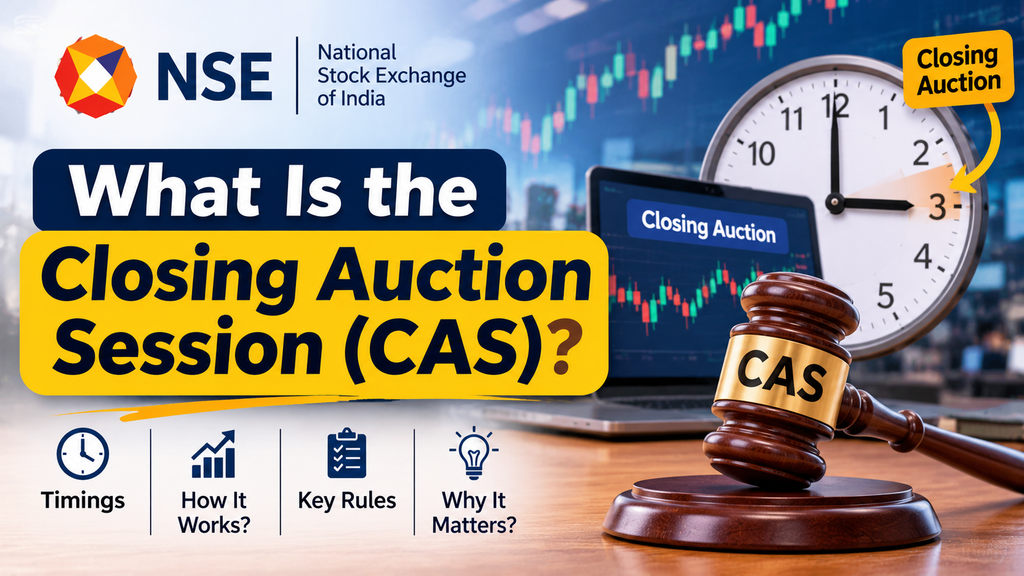
The Closing Auction Session is a separate call-auction process conducted after the Continuous Trading Session (CTS). Its purpose is to determine the closing price of eligible shares by bringing buy and sell orders together and identifying a price at which the highest possible quantity can be traded.
The NSE Closing Auction Session 2026 is essential for effective trading strategies.
Traders must stay informed about the NSE Closing Auction Session 2026 to make wise investment choices.
The changes coming with the NSE Closing Auction Session 2026 will be crucial for all investors.
Following the NSE Closing Auction Session 2026 will be important for navigating market volatility.
The structure of the NSE Closing Auction Session 2026 will enhance trading efficiency.
Adhering to the new rules of the NSE Closing Auction Session 2026 is essential for traders.
The NSE Closing Auction Session 2026 plays a critical role in the market’s operational framework.
During normal continuous trading, orders can match as soon as compatible buy and sell prices meet. A call auction works differently. Orders are collected for a defined period. The exchange then uses the complete set of eligible buy and sell orders to calculate an equilibrium price. Trades are matched at the end of the collection window, rather than continuously throughout that window.
Awareness of the NSE Closing Auction Session 2026 will help traders maximize their returns.
The NSE Closing Auction Session 2026 is critical for effective trade execution.
Being knowledgeable about the NSE Closing Auction Session 2026 helps navigate market complexities.
In simple terms, CAS gives the market a dedicated period to collect interest from buyers and sellers before the exchange calculates the closing price. It is designed to support a more orderly and transparent closing-price discovery process.
Why Has SEBI Introduced a Closing Auction Session?
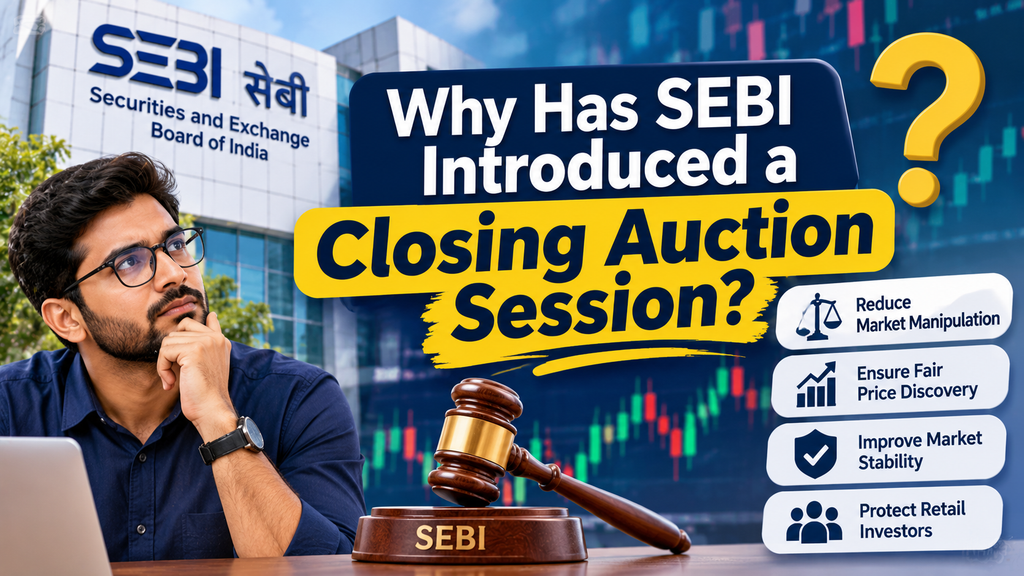
Before CAS, the closing price of a share was generally determined using the volume-weighted average price of trades executed during the last 30 minutes of the continuous trading session. SEBI’s January 2026 circular introduced the CAS framework to improve the transparency and efficiency of closing-price discovery.
The closing price matters beyond the final number shown on a trading screen. It is used in several market processes, including valuation and benchmark calculations. A dedicated auction can bring more orders into one price-discovery process instead of relying only on trades that happened during a time window.
That does not mean an auction guarantees a “correct” price or removes volatility. The price still depends on the orders submitted by market participants, the available liquidity and the exchange’s matching rules. CAS changes the method used to discover the closing price; it does not remove market risk.
The NSE Closing Auction Session 2026 is a pivotal process for determining closing prices.
When Will the New NSE CAS Rules Start?
CAS itself was introduced earlier in 2026. After reviewing how the framework was operating, SEBI issued a revised circular on 15 October 2026. NSE then published revised operational circulars on 6 November 2026.
The main changes are scheduled to become effective from 7 December 2026. However, SEBI has given a later implementation date for the specific provisions dealing with unexecuted limit and iceberg orders moving from the continuous session into CAS. Those provisions are scheduled to take effect from 8 February 2027.
This two-date implementation is important. Traders should not assume that every order-transition change begins on 7 December.
Which Stocks Will Be Eligible for CAS?
The revised framework applies to securities in the equity cash segment on which derivative contracts are available on at least one recognised stock exchange. In practical terms, this means that the CAS process is not automatically applicable to every NSE-listed share.
NSE has provided a CAS identifier in its equity security master data to help members identify eligible securities. Traders can also check the exchange’s published eligible-security information and their broker’s updated trading interface.
There are specified situations in which CAS will not be conducted for an otherwise eligible security. These include the ex-date of a scheme of arrangement where a price is not determined during the Special Pre-Open Session, and a day on which an index circuit breaker halts trading for the remainder of the day.
CAS is an equity cash-segment process. The related changes to stock and index derivatives timings are separate provisions and should not be confused with the cash-market auction itself.
NSE Closing Auction Session Timings from 7 December 2026
The revised CAS order-collection window is 10 minutes, from 3:30 pm to 3:40 pm. Order matching and trade confirmation then take place from 3:40 pm to 3:45 pm.
| Session stage | Timing | What happens |
|---|---|---|
| Reference price calculation and transition | 3:30 pm–3:31 pm | The exchange calculates and disseminates the reference price and transitions eligible securities from CTS to CAS. |
| Order entry: market and limit orders | 3:31 pm–3:36 pm | New market and limit orders can be entered, modified or cancelled. |
| Order entry: limit orders only | 3:36 pm–random close between 3:38 pm and 3:40 pm | Limit orders can be entered, modified or cancelled. Market orders cannot be modified or cancelled, and no new market orders are accepted. |
| Order matching and trade confirmation | 3:40 pm–3:45 pm | The exchange matches eligible orders using the auction price-discovery rules. |
| Transition to post-close | 3:45 pm–3:50 pm | Transition from CAS to the post-close session. |
| Post-close session | 3:50 pm–4:00 pm | Eligible post-close trades take place at the closing price, as per the applicable session rules. |
The order-entry window is scheduled to close randomly between 3:38 pm and 3:40 pm. It is system-driven, so traders should not assume that orders can be entered right up to 3:40 pm.
What Is Changing Compared With the Earlier CAS Schedule?
The earlier CAS schedule used a 20-minute session from 3:15 pm to 3:35 pm. Under the revised framework, the cash-market continuous session for CAS-eligible securities runs up to 3:30 pm, followed by a 10-minute order-collection window and a separate matching period.
| Stage | Earlier schedule | Revised schedule from 7 Dec 2026 |
|---|---|---|
| Reference price / transition | 3:15 pm–3:20 pm | 3:30 pm–3:31 pm |
| Order collection | 3:20 pm–3:30 pm | 3:31 pm–random close between 3:38 pm and 3:40 pm |
| Matching / confirmation | 3:30 pm–3:35 pm | 3:40 pm–3:45 pm |
| Transition to post-close | 3:35 pm–3:50 pm | 3:45 pm–3:50 pm |
| Post-close session | 3:50 pm–4:00 pm | 3:50 pm–4:00 pm |
The main difference is that eligible cash shares now remain in the continuous session until 3:30 pm, and the auction’s order collection and matching stages follow that point. The post-close session remains scheduled for 3:50 pm to 4:00 pm.
How Is the CAS Reference Price Calculated?
For a CAS-eligible cash-market share, the reference price is based on the Volume Weighted Average Price (VWAP) of trades executed during the final 15 minutes of the Continuous Trading Session, from 3:15 pm to 3:30 pm.
VWAP gives more weight to prices at which a larger quantity was traded. It is not simply the last traded price or a normal arithmetic average of every trade price.
If no trade takes place in the share during the 3:15 pm–3:30 pm period, the day’s Last Traded Price (LTP) is used as the reference price. If there has been no trade at all during the day, the previous trading day’s closing price is used. For a corporate-action situation, the applicable adjustable closing price or base price is used.
What Is the CAS Price Band?
The revised framework provides a price band of 3% above and 3% below the CAS reference price.
Simple example (illustrative only)
Suppose a share has a CAS reference price of ₹1,000.
- 3% of ₹1,000 = ₹30
- Lower CAS price band = ₹970
- Upper CAS price band = ₹1,030
The eligible auction orders are considered within the applicable band. This example explains the calculation; it is not a prediction of where the share will close.
The reference price and price band are calculated independently on each exchange. Therefore, traders should not assume that the closing-auction reference price will necessarily be identical across exchanges.
How Does CAS Decide the Final Closing Price?
The auction system uses the demand and supply available in the order book. It looks for an equilibrium price at which the maximum possible quantity can be executed.
The selection process follows a defined sequence:
- Maximum executable quantity: The system first looks for the price at which the highest volume can be matched.
- Minimum order imbalance: If more than one price allows the same maximum executable quantity, the price with the smallest unmatched quantity is preferred.
- Closest to the reference price: If the imbalance is also equal, the price closest to the reference price is selected. The exchange FAQ also explains the tie-breaking case where the reference price lies midway between the two closest prices.
Both market orders and limit orders are considered while calculating the equilibrium price. If an equilibrium price is not determined, the reference price is used as the closing price for that eligible security.
For example, imagine that buyers and sellers submit orders at several prices during the collection window. The exchange does not simply select the highest buy order or the lowest sell order. It evaluates the combined order book and selects the price that best satisfies the auction’s matching criteria.
Which Orders Are Allowed During CAS?
Only limit orders and market orders are allowed to be placed during CAS. However, market orders are not accepted throughout the entire order-entry period.
| Order type | CAS treatment |
|---|---|
| Limit order | Allowed during the order-entry window, subject to the applicable price band. |
| Market order | Allowed from 3:31 pm to 3:36 pm. New market orders are restricted after 3:36 pm; modification and cancellation of existing market orders are also not allowed during the restricted period. |
| Stop-loss order | Not permitted to be placed during CAS. |
| Immediate or Cancel (IOC) | Not permitted during the CAS order-entry period. |
| Disclosed Quantity / new iceberg order | Not permitted as a new order during CAS. |
One practical point for traders: CAS is an order-collection and matching process, not a normal continuous market. A market order placed in the permitted window does not mean that it will be executed immediately at the moment it is submitted. Execution depends on the final auction result and the applicable priority rules.
NSE’s CAS FAQ also states that Self-Trade Prevention (STP) remains applicable, while Market Price Protection (MPP) is not applicable during CAS. Orders are generally subject to applicable margin checks at order level; the specified exception applies to qualifying limit and iceberg orders carried forward from CTS, but a modification to such an order brings it under the applicable order-level margin check. These controls are particularly relevant for brokers and algorithmic order systems.
What Happens to Unexecuted Orders? Important 8 February 2027 Change
This is one of the areas where the implementation dates need to be read carefully.
SEBI has separated the general CAS changes from the rules on carrying pending limit and iceberg orders from CTS into CAS. Most revised provisions are scheduled for 7 December 2026, while the provisions in paragraph 4.8 of the SEBI circular are scheduled for 8 February 2027.
Under the paragraph 4.8 framework scheduled for 8 February 2027:
- Unexecuted limit orders pending at the end of CTS are to be carried forward to CAS, except stop-loss orders and orders priced outside the applicable CAS band.
- Eligible unexecuted iceberg orders within the CAS band are to be carried forward as fully disclosed limit orders, unless the market participant has opted out when placing the original order.
- Converted iceberg orders receive lower time priority than other limit orders carried forward from CTS.
- Orders carried forward from CTS receive higher time priority than limit orders newly placed during CAS.
- Modifying a carried-forward order changes its time priority under the SEBI framework.
This is different from placing a new iceberg order during CAS, which is not allowed. A qualifying iceberg order carried over from CTS is converted into a fully disclosed limit order under the deferred February 2027 provision.
NSE’s 6 November 2026 FAQ describes the interim handling of pending orders and identifies stop-loss, iceberg/disclosed-quantity and out-of-band orders among those that are not carried forward under that process. The SEBI paragraph 4.8 changes are deferred to 8 February 2027. Brokers and trading members should communicate the applicable treatment for each phase. Traders should check their broker’s order book and exchange notices rather than assume that every pending order will automatically remain active.
Also note that any order left unexecuted after the CAS matching phase is cancelled by the exchange. A trade that has already been executed during CAS cannot be cancelled through a trade-cancellation request.
The NSE Closing Auction Session 2026 is a game-changer for closing price determination.
Investors should embrace the NSE Closing Auction Session 2026 for better market predictions.
The transition to the NSE Closing Auction Session 2026 is vital for modern trading.
How Will CAS 2.0 Change F&O Trading Timings?
CAS itself applies to the equity cash segment, but the revised framework also changes the trading hours for equity derivatives. The schedule is not identical for stock derivatives and index derivatives on expiry days.
| Segment | Normal trading day | Expiry day |
|---|---|---|
| Stock derivatives | Trading continues until 3:45 pm. | Trading continues until 3:45 pm. |
| Index derivatives | Trading continues until 3:45 pm. | Trading in the expiring index derivatives contracts ceases at 3:30 pm. |
| Equity cash shares not eligible for CAS | Continuous trading continues until 3:30 pm. | The same cash-market session timing applies, subject to exchange notices. |
Trade modification end time for the equity derivatives segment is 4:15 pm, as specified in the NSE FAQ. Traders should still verify the exact product and contract schedule on their broker’s platform, especially on expiry days.
Does the CAS Closing Price Decide F&O Expiry Settlement?
No. This is an important distinction in the revised framework. The cash-market closing price for a CAS-eligible share is discovered through CAS. However, SEBI’s October 2026 circular separately revises the method used to determine the final settlement price of expiring stock and index derivatives contracts.
- Expiring index derivatives: The settlement price is based on the underlying index value calculated using the VWAP of its constituent securities during the last 30 minutes of the Continuous Trading Session in the equity cash segment.
- Expiring stock derivatives: The clearing corporations determine the settlement price using the VWAP of the underlying stock during the last 30 minutes of CTS in the cash segment across all stock exchanges.
Incorporating insights from the NSE Closing Auction Session 2026 can enhance trading results.
The impact of the NSE Closing Auction Session 2026 resonates with all market traders.
Understanding the NSE Closing Auction Session 2026 can lead to smarter trading strategies.
Under the revised schedule, the final 30 minutes of the cash-market CTS runs up to 3:30 pm. The expiry settlement methodology therefore uses the specified CTS-period VWAP data; it should not be described as simply using the CAS equilibrium closing price.
Investors will need to adapt to the changes brought by the NSE Closing Auction Session 2026.
This matters to F&O traders because the stock’s CAS closing price and the final settlement price of an expiring derivative contract are related to the same underlying market, but they are not interchangeable numbers under the revised methodology.
What Should Intraday and F&O Traders Keep in Mind?
The revised session does not automatically create a trading opportunity. It changes the way the closing price is discovered and the time available to place or manage certain orders. Here are practical points worth adding to your end-of-day routine.
- Identify CAS-eligible shares: Do not assume that every stock follows the auction process. Check the CAS indicator or your broker’s updated security information.
- Do not leave stop-loss orders for the auction: Stop-loss orders are not permitted in CAS. Review open orders before the continuous session ends.
- Know the market-order cut-off: Market orders are restricted after 3:36 pm. The final order-entry closure is random between 3:38 pm and 3:40 pm.
- Understand how pending orders are handled: The February 2027 transition rules for eligible CTS limit and iceberg orders are different from the rules for placing fresh orders in CAS.
- Do not treat an indicative price as a confirmed closing price: The final equilibrium price is known after order collection closes and matching is completed.
- Recheck expiry-day F&O positions: Expiring index derivatives stop trading at 3:30 pm, while stock derivatives continue to 3:45 pm under the revised schedule.
- Separate cash closing price from F&O settlement price: The expiry settlement calculation follows the specified 30-minute CTS VWAP methodology.
The NSE Closing Auction Session 2026 will redefine trading approaches in the coming years.
For traders who base their decisions on price action, the final cash-market candle and closing levels may need to be interpreted with the new auction process in mind. A closing price generated through an auction is not the same thing as a normal last-minute continuous-market trade.
What CAS 2.0 Does Not Mean
- It does not apply to every listed share. Eligibility depends on the availability of derivatives contracts and the exchange’s applicable list.
- It does not extend normal cash-market trading for non-CAS securities to 3:45 pm.
- It does not mean that all F&O contracts trade until 3:45 pm on expiry day. Expiring index derivatives stop at 3:30 pm; stock derivatives continue to 3:45 pm.
- It does not guarantee that every order placed in the auction will be executed.
- It does not mean that the CAS closing price is automatically the expiry settlement price for stock and index derivatives.
Frequently Asked Questions About NSE Closing Auction Session
1. What is the effective date of NSE CAS 2.0?
The main revised CAS provisions are scheduled to take effect on 7 December 2026. The specific provisions governing the transition of unexecuted limit and iceberg orders from CTS to CAS are scheduled to take effect on 8 February 2027.
2. What are the new CAS timings?
The reference-price and transition period is 3:30 pm to 3:31 pm. The order-entry window runs from 3:31 pm to a system-driven random close between 3:38 pm and 3:40 pm. Matching and trade confirmation take place from 3:40 pm to 3:45 pm.
3. Does CAS apply to all NSE stocks?
No. CAS applies to eligible cash-market securities that have derivative contracts available on at least one recognised exchange, subject to the exceptions specified by the exchange and SEBI.
4. What is the CAS reference price?
It is normally the VWAP of the share’s trades from 3:15 pm to 3:30 pm. If there are no trades in that period, the day’s LTP is used. If there has been no trade during the day, the previous trading day’s closing price is used, subject to corporate-action adjustments where applicable.
5. What is the CAS price band?
The applicable CAS price band is 3% above and 3% below the reference price. For example, a reference price of ₹1,000 results in an illustrative range of ₹970 to ₹1,030.
6. Can traders place market orders during the entire CAS window?
No. Market orders can be entered from 3:31 pm to 3:36 pm. After 3:36 pm, new market orders are restricted and existing market orders cannot be modified or cancelled. Limit orders can be managed until the system-driven random closure.
Investors who leverage the NSE Closing Auction Session 2026 will be better positioned in the market.
7. Can a stop-loss order be placed during CAS?
No. Stop-loss orders are not permitted during CAS. Traders should review their open orders and broker instructions before the auction begins.
8. Is the CAS closing price used for F&O expiry settlement?
Not under the revised settlement methodology. Expiring index and stock derivatives use the prescribed VWAP-based calculation over the last 30 minutes of the cash-market Continuous Trading Session.
Related Trading Guides from Trade4Wealth
Readers who want to understand the wider market concepts behind this update may also find these guides useful:
- What Is Price Action Trading?
- SEBI F&O Rules 2026: Lot Size, Expiry and STT Changes
- Risk Management in Trading: Stop-Loss and the 1% Rule
- Intraday vs Swing vs Positional Trading
Official Sources and Further Reading
The rules and dates in this article are based primarily on SEBI and NSE documents. Readers should refer to the latest circulars and exchange notices if any further amendments are issued.
- SEBI Circular dated 15 October 2026 – Review of CAS, market timings and derivatives settlement methodology
- NSE FAQ – Closing Auction Session (CAS) 2.0, applicable from 7 December 2026 (updated 6 November 2026)
- SEBI Circular dated 16 January 2026 – Introduction of Closing Auction Session
About this article: Prepared for educational purposes by Trade4Wealth. This article explains exchange procedures and regulatory changes; it is not investment advice or a recommendation to buy or sell any security or derivative contract. Trading and derivatives involve risk. Confirm broker-specific order handling and the latest exchange circulars before placing orders.