Risk Management in Trading: Stop Loss & 1% Rule
Risk Management in Trading: Stop Loss & 1% Rule
 admin
Meta Description: Learn risk management in trading with practical examples of stop loss, position sizing, the 1% rule, risk-to-reward ratio, and daily loss limits.
URL Slug: risk-management-in-trading-stop-loss-position-sizing-1-percent-rule
Primary Keyword: Risk Management in Trading
Secondary Keywords: Stop Loss in Trading, Position Sizing, 1% Rule in Trading, Risk-to-Reward Ratio, Trading Risk Management for Beginners, Stop Loss Strategy, Stock Market Trading for Beginners
Risk Management in Trading: Stop Loss, Position Sizing and the 1% Rule Explained
Learning a trading strategy is important, but identifying the right entry and exit points is not enough. Every trader must also understand how much they could lose if a trade moves against their expectations.
This process is known as risk management in trading.
For example, suppose you have ₹1,00,000 in your trading account. You enter a trade, but the market starts moving in the opposite direction. Without a predefined stop loss, position size, and maximum acceptable loss, a single trade could result in a larger loss than you originally intended.
According to SEBI’s FY25–FY26 study on the profitability of individual traders in the equity derivatives segment, approximately 87.7% of individual traders incurred net losses in the equity derivatives segment during FY26.
This data highlights why understanding trading risk is important. No risk-management method can guarantee profits, but having a plan can help traders distinguish between controlled, predefined risk and unplanned losses.
In this guide, we explain stop loss, position sizing, the risk-to-reward ratio, and the 1% rule with simple, practical examples.

1. What Is Risk Management in Trading?
Risk management in trading is the process of evaluating potential losses before entering a trade and deciding how much capital to put at risk. It helps traders plan their exposure, establish exit rules, and make more disciplined trading decisions.
The key components of trading risk management include:
- Stop Loss: A predetermined price level at which a trader plans to exit a position.
- Position Sizing: The number of shares or contracts to trade based on the available risk budget.
- Risk-to-Reward Ratio: The relationship between the potential loss and the potential profit of a trade.
- Maximum Daily Loss: A predefined loss limit for a trading session.
- Trading Journal: A record of trades, costs, mistakes, and results.
The objective of risk management is not to make every trade profitable. It is to plan for potential losses, identify unnecessary exposure, and maintain discipline while trading.
SEBI’s Investor Education website also advises investors to consider their risk appetite, financial situation, and investment goals before making investment decisions.
2. What Is a Stop Loss in Trading?
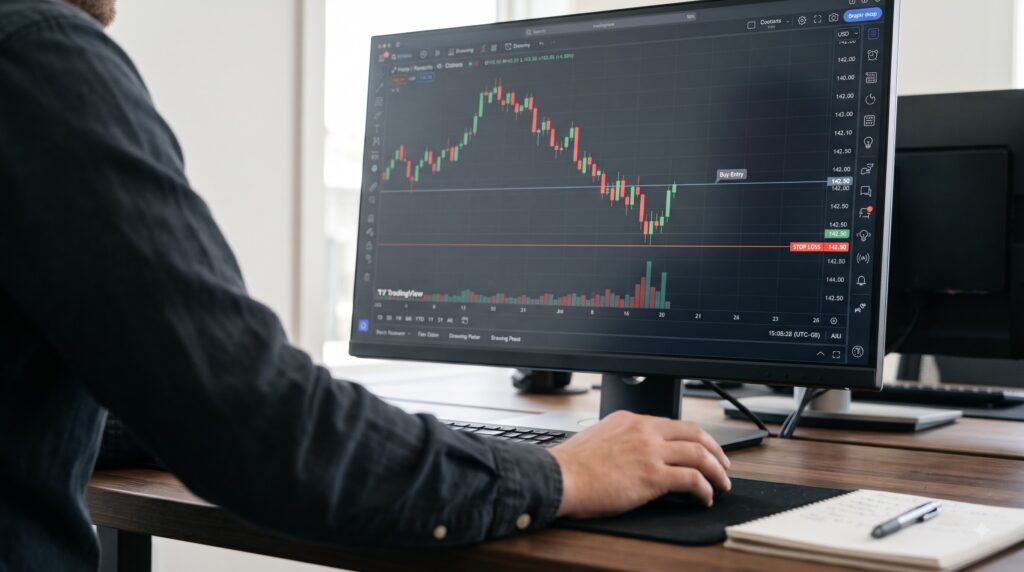
A stop loss is a predetermined price level at which a trader plans to close a position if the market does not move in the expected direction.
For example, suppose you buy a stock at ₹500. Based on your analysis, a price movement below ₹490 would invalidate your trading setup. You may therefore identify ₹490 as your planned stop-loss level.
If your exit is executed at ₹490, your loss would be ₹10 per share, excluding brokerage and other applicable costs.
However, it is important to understand that a stop loss does not guarantee execution at the exact trigger price. Market gaps, volatility, low liquidity, and order type can cause the actual exit price to differ from the planned level.
You can also review SEBI’s securities market resources and the NSE Risk Management resources to learn more about market-related risks.
How to Decide Where to Place a Stop Loss
Instead of selecting a stop loss based only on an arbitrary percentage, evaluate the point at which your trading setup would no longer be valid.
For example:
Support-Based Stop Loss: If your trade is based on a support zone, a move below that zone may invalidate the trading setup.
Swing-Based Stop Loss: In swing trading, a recent swing high or swing low can be considered as part of the stop-loss analysis.
Volatility-Based Stop Loss: Consider the market’s normal price movement and volatility when evaluating the distance between your entry and stop-loss levels.
These are educational approaches. No single stop-loss method is suitable for every trading strategy or market condition.
Common Types of Stop-Loss Orders
Stop-Market Order: Once the trigger condition is met, a market order is used to attempt an exit. In a fast-moving market, the execution price may differ from the trigger price.
Stop-Limit Order: Once triggered, a limit order is placed. It will not execute at a price worse than the specified limit, but it may remain unfilled if the market does not reach that limit price.
Order availability, terminology, and exact behaviour may vary depending on the broker and exchange rules. Review your broker’s documentation before using an order type.

3. What Is Position Sizing in Trading?
Position sizing refers to deciding how many shares or contracts to buy or sell so that the planned loss remains within your predefined risk budget.
Suppose you have ₹1,00,000 in trading capital. You might take a position worth ₹10,000 or ₹50,000. However, the total value of a position and the amount you are risking are not the same thing.
Your planned risk depends on the entry price, stop-loss distance, and quantity traded.
Position Sizing Formula
Position Size = Maximum Permitted Risk ÷ Risk Per Unit
For a simple stock-buying example:
Risk Per Share = Entry Price − Stop-Loss Price
Suppose:
- Trading capital: ₹1,00,000
- Maximum planned risk: ₹1,000
- Entry price: ₹500
- Stop-loss price: ₹490
- Risk per share: ₹10
Therefore:
Position Size = ₹1,000 ÷ ₹10
Position Size = 100 shares
If you buy 100 shares at ₹500, the total position value will be ₹50,000.
If the position is exited at ₹490, the planned gross loss will be:
100 shares × ₹10 = ₹1,000
This calculation excludes brokerage, taxes, slippage, and any difference between the planned and actual execution price. Your actual loss may therefore be higher.
When calculating position size in a live market, leave room for additional costs and execution risks.
For a more detailed explanation, read Zerodha Varsity’s guide to Position Sizing.

4. What Is the 1% Rule in Trading?
The 1% rule is a commonly discussed risk-management guideline. Under this approach, a trader may choose to limit the planned risk on a single trade to approximately 1% or less of their trading capital.
Important: The 1% rule is not a mandatory SEBI regulation, nor does it guarantee that losses will never exceed 1%. The appropriate risk level may vary based on a trader’s financial situation, strategy, trading instrument, and risk tolerance.
1% Rule in Trading: Example
Suppose your trading capital is ₹1,00,000.
| Trading Capital | Illustrative Risk Percentage | Planned Risk Amount |
|---|---|---|
| ₹50,000 | 1% | ₹500 |
| ₹1,00,000 | 1% | ₹1,000 |
| ₹2,00,000 | 1% | ₹2,000 |
| ₹5,00,000 | 1% | ₹5,000 |
If your trading capital is ₹1,00,000 and you choose to follow the 1% guideline, your planned risk budget would be ₹1,000.
This does not mean you should take a position worth ₹1,00,000 on every trade. You must calculate the position size based on the stop-loss distance and the instrument you are trading.
A wider stop-loss distance may require a smaller position size. If a trade cannot fit within your planned risk budget at a reasonable position size, skipping the trade is also an option.
Should Every Trader Follow the 1% Rule?
Not necessarily.
The 1% rule is an educational reference point, not a universal requirement. Some traders may choose a lower risk level. Before deciding how much to risk, consider:
- Your trading experience and strategy performance.
- Your available capital and financial obligations.
- The volatility of the instrument.
- Your ability to tolerate consecutive losses.
- Transaction costs and execution risks.
Trading capital should not include money required for essential household expenses, emergencies, or short-term financial obligations.
5. How to Combine the 1% Rule and Position Sizing
Let’s combine both concepts using a practical example.
Suppose:
- Total trading capital: ₹2,00,000
- Chosen risk guideline: 1%
- Maximum planned risk: ₹2,000
- Stock entry price: ₹800
- Planned stop-loss price: ₹780
- Risk per share: ₹20
Position Size = ₹2,000 ÷ ₹20
Position Size = 100 shares
The total position value will be:
100 × ₹800 = ₹80,000
If the stop loss is executed at ₹780, the estimated gross loss will be:
100 × ₹20 = ₹2,000
In this example, ₹80,000 is the position value, while ₹2,000 is the planned risk. These two figures should not be confused.
If the market gaps down and the actual exit takes place below ₹780, the loss may exceed ₹2,000. Transaction costs will also affect the net result.
In live trading, you may need to adjust the quantity to account for additional costs and potential slippage.
6. How to Apply Risk Management in Options Trading
Position sizing and stop-loss planning are particularly important in options trading. An option’s value can be affected by the underlying asset, time to expiry, volatility, and other factors.
Risk Management for Option Buying
For an option buyer, the maximum loss is generally the premium paid if the contract expires worthless, excluding transaction costs.
For example, suppose an option premium is ₹100 and the illustrative lot size is 50. The premium cost for one lot would be:
₹100 × 50 = ₹5,000
If the buyer loses the entire premium, the gross loss would be ₹5,000.
Suppose the trader’s chosen planned risk budget is ₹2,000. This position would not fit within that budget because the total premium cost is already ₹5,000. Always verify the applicable lot size and contract specifications with your broker or the exchange.
Risk Management for Option Selling
The payoff and risk profile of option selling are different from those of option buying. Unhedged short-option positions can involve substantial losses. A stop-loss order also does not guarantee an exit at the exact trigger price.
Therefore, deciding the position size in options trading based only on the premium is not sufficient. Traders should understand contract specifications, payoff profiles, margin requirements, expiry-related risks, and potential adverse market movements.
The NSE Equity Derivatives Risk Management page provides an overview of margin and risk-containment systems in the derivatives market.
Beginners should understand how derivatives work and assess their risk profile before trading complex options strategies.
7. What Is the Risk-to-Reward Ratio in Trading?
The risk-to-reward ratio compares the potential loss on a trade with its planned potential profit.
Consider this example:
- Entry price: ₹500
- Stop-loss price: ₹490
- Planned target: ₹520
Potential risk per share = ₹500 − ₹490 = ₹10
Potential reward per share = ₹520 − ₹500 = ₹20
Risk-to-Reward Ratio = ₹10 : ₹20
This gives a 1:2 risk-to-reward ratio.
It means the planned reward is twice the potential risk. However, it does not mean the probability of a successful trade is twice as high.
The market may reverse before reaching the target. Slippage, brokerage, and other charges can also affect the actual result.
To evaluate a trading strategy, consider its win rate, average winning trade, average losing trade, transaction costs, and execution quality together.
8. Maximum Daily Loss and Trading Capital Protection
Planning the risk for each individual trade may not be enough. When multiple trades are taken in one session, their combined risk and losses can become significant.
For this reason, some traders define a maximum daily loss as part of their trading plan.
For example, a trader may decide that once a specified loss level is reached, they will not open any new trades for the rest of the session. The appropriate limit should depend on the trader’s risk tolerance and strategy. There is no single percentage that is suitable for everyone.
Consider the following factors when setting a daily risk limit:
- Combined risk across open positions.
- Exposure to the same sector or correlated instruments.
- Consecutive losses.
- Market volatility and scheduled events.
- Transaction costs and potential overnight gaps.
If several positions may be affected by the same market movement, treating their risks as completely independent can be misleading.
An important part of risk management is avoiding emotional decisions after a loss and following the rules defined in your trading plan.
9. Seven Common Risk Management Mistakes in Trading
Mistake 1: Trading Without a Stop Loss
Entering a trade without an exit plan can expose you to losses greater than expected. Identify the invalidation level and exit approach before entering a position.
Mistake 2: Placing a Stop Loss Only at a Round Number
Using a fixed distance, such as ₹5 or ₹10, may not be suitable for every instrument or trading setup. Consider market structure, volatility, and the reason behind the trade.
Mistake 3: Increasing Position Size After a Loss
Increasing the quantity on the next trade to recover a previous loss can unnecessarily increase risk. Calculate the risk for every trade independently.
Mistake 4: Repeatedly Widening the Stop Loss
Moving a stop loss farther away simply to avoid booking a loss can increase the risk beyond the original plan. Any adjustment should be evaluated according to predefined strategy rules.
Mistake 5: Ignoring Transaction Costs
Looking only at gross profit and gross loss is not enough. Brokerage, applicable taxes, exchange charges, and slippage can all affect net trading results.
Mistake 6: Treating Correlated Trades as Independent
Multiple positions linked to the same index, sector, or similar stocks may all be affected by one adverse market move. Monitor the combined exposure rather than evaluating each position in isolation.
Mistake 7: Treating the 1% Rule as Guaranteed Protection
The 1% guideline can help structure planned risk, but market gaps, execution issues, and unexpected price movements may cause the actual loss to differ. It does not eliminate trading risk.
10. Risk Management Checklist Before Every Trade
Use this checklist before entering a trade:
- [ ] Do I have a clear reason for entering this trade?
- [ ] Have I identified the level at which my trading setup becomes invalid?
- [ ] Is the stop loss appropriate for the market structure and strategy?
- [ ] Have I calculated the correct position size?
- [ ] Is the planned loss within my predefined risk limit?
- [ ] Have I considered transaction costs and possible slippage?
- [ ] Is my combined exposure across multiple trades reasonable?
- [ ] Am I trading under pressure to recover a previous loss?
- [ ] Am I prepared to skip the trade if the risk is not acceptable?
The purpose of this checklist is not to make a trade profitable. It is to help you review important risk factors before making a trading decision.
To understand the differences between manual and automated trading, read Manual Trading vs Algo Trading: What’s the Real Difference?.
For structured stock market education and practical learning, you can also explore the training resources at Trade4Wealth Trading Academy in Borivali.
Conclusion: Calculate Your Risk Before Deciding Your Position Size
Risk management is an essential part of a structured trading process. A stop loss helps define an exit plan, position sizing helps determine the quantity based on planned risk, and the 1% rule provides one possible guideline for setting a risk budget.
However, none of these methods guarantees profits or assures a fixed maximum loss.
Before entering any trade, evaluate the entry point, exit plan, potential loss, position size, and transaction costs. Record your trades in a journal and review your strategy’s performance using sufficient data.
A disciplined trading process is not only about targeting profits; it is also about understanding risk and making informed decisions.
Disclaimer: This article is for educational and informational purposes only. It does not constitute investment advice, a research recommendation, or a buy/sell call. Stock market and derivatives trading involve a substantial risk of financial loss. The 1% rule is an illustrative risk-management guideline and is not a mandatory SEBI rule. Consider your financial situation and risk tolerance before making trading decisions.
Frequently Asked Questions (FAQs) About Risk Management in Trading
1. What Is Risk Management in Trading?
Risk management in trading is the process of evaluating potential losses, position size, stop-loss levels, and overall exposure before and during a trade. Its objective is to plan trading risk and manage the possibility of unplanned losses.
2. What Is the 1% Rule in Trading?
The 1% rule is a commonly discussed guideline under which a trader chooses to limit the planned risk on a single trade to approximately 1% of their trading capital. It is not a mandatory SEBI rule, and the appropriate risk level may differ from one trader to another.
3. How Do You Calculate a Stop Loss in Trading?
A stop-loss level can be selected based on the trading setup and the price level at which the setup becomes invalid. The difference between the entry price and stop-loss price is then used to calculate the risk per unit and determine the position size.
4. What Is the Formula for Position Sizing?
The basic formula is: Position Size = Maximum Permitted Risk ÷ Risk Per Unit. When calculating the actual quantity, also consider transaction costs, slippage, instrument specifications, and execution risks.
5. Can a Stop Loss Completely Prevent Trading Losses?
No. A stop loss helps define an exit plan, but market gaps, volatility, liquidity conditions, and order type may cause the actual execution price to differ from the trigger price.
6. Can the 1% Rule Be Used in Options Trading?
The 1% rule may be considered as a risk-budget guideline, but options have a different payoff and risk profile. Before deciding the position size, consider the contract cost, lot size, expiry, potential loss, and execution risks.
7. What Is the Risk-to-Reward Ratio?
The risk-to-reward ratio compares the potential loss with the planned potential profit of a trade. For example, if the planned risk is ₹10 per share and the planned reward is ₹20 per share, the ratio is 1:2. This ratio does not guarantee the probability of a successful trade.
8. How Can Traders Protect Their Trading Capital?
Useful practices may include setting predefined risk limits, using suitable position sizing, planning stop-loss levels, accounting for transaction costs, monitoring combined exposure, and maintaining a trading journal. However, no practice can completely eliminate market risk.
Additional Resources on Trading Risk Management
To understand trading risk management, stop-loss orders, and position sizing in greater detail, explore these educational resources from trusted financial institutions:
- SEBI Guide to Securities Market Investment Risks – Learn about market risk, volatility risk, liquidity risk, and investment risk management.
- NSE India – Understanding Stop Loss Orders – Understand stop-loss order types, trigger prices, and how stop-loss orders work in the trading system.
- Zerodha Varsity – Position Sizing for Active Traders – Explore position sizing concepts and learn why managing trade quantity is important for protecting trading capital.
These resources can help traders build a better understanding of risk management and make more informed trading decisions.