
SEBI F&O New Rules 2026 Lot Size , Expiry & STT Changes
 admin
Updated: 28 October 2026
Source: Official SEBI F&O Rules and Circulars
SEBI F&O New Rules 2026: Overview
SEBI F&O New Rules 2026 are important for traders who participate in Futures and Options (F&O) trading in the Indian stock market. Traders need to understand lot sizes, expiry dates, margin requirements, and transaction costs. Over the past few years, SEBI, NSE, and BSE have made several changes to the equity derivatives framework.
The most important changes for traders in 2026 include revised index lot sizes, an increase in Securities Transaction Tax (STT) from 1 April 2026, and closing-session and derivatives-settlement changes scheduled to be implemented from December 2026.
However, keep in mind that not all F&O rules were introduced in 2026. Measures such as the availability of weekly index contracts, minimum contract value, and expiry-day margin were announced in 2024. Upfront collection of options premium was implemented in 2025, while lot-size and expiry-related changes came into effect across different contract cycles.
This guide to SEBI F&O New Rules 2026 explains revised lot sizes, expiry changes, and the latest STT rates in simple English, based on official SEBI and NSE circulars.
1. SEBI F&O New Rules 2026: Complete Timeline of Important Changes
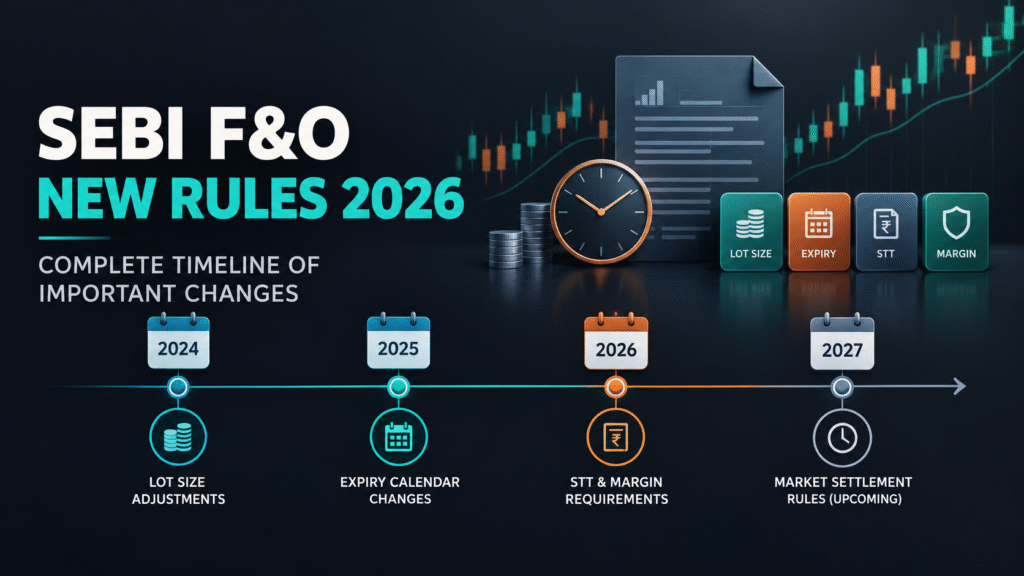
To understand F&O rules, it is important to review the dates in chronological order.
| Effective Date | Rule Change | What Is Important for Traders? |
|---|---|---|
| 1 October 2024 | STT rates increased | STT increased on options sales and futures sales |
| 20 November 2024 | Availability of weekly index contracts restricted | Weekly contracts were available for only one benchmark index per exchange |
| 20 November 2024 | Minimum index contract value revised | Minimum contract value was ₹15 lakh at the time of introduction |
| 20 November 2024 | Expiry-day ELM | Additional 2% ELM on short options expiring that day |
| 1 February 2025 | Upfront collection of options premium | Collecting the net premium upfront from option buyers |
| 1 February 2025 | Removal of expiry-day calendar-spread benefit | Relevant calendar-spread margin benefit removed for contracts expiring that day |
| 1 April 2025 | Intraday position-limit monitoring | At least four randomly timed snapshots during the trading day |
| From September 2025 onwards | Expiry weekday transition | Tuesday expiry under NSE’s revised expiry schedule |
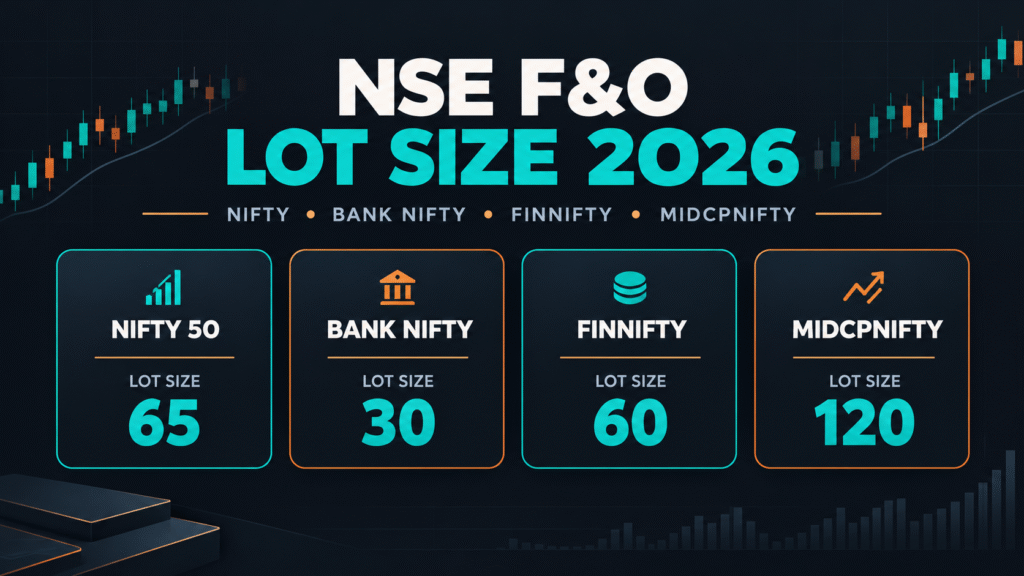
| January 2026 contract cycles | Revised NSE index lot sizes | Nifty 65, Bank Nifty 30, FINNIFTY 60, and MIDCPNIFTY 120 |
| 1 April 2026 | STT rates increased again | Futures 0.05%, options sale 0.15%, exercised options 0.15% |
| 7 December 2026 | Closing Auction Session and settlement-related changes scheduled | Revised market timings and expiry-settlement methodology |
| 8 February 2027 | Selected order-transition provisions scheduled | Revised treatment of unexecuted orders moving from the Continuous Trading Session to the auction session |
Official references: SEBI October 2024 derivatives framework, NSE revised lot-size circular, Finance Bill 2026, and SEBI October 2026 circular.
Important: As of 28 October 2026, the changes scheduled for December 2026 and February 2027 have been announced, but their respective effective dates are still in the future. It would be incorrect to treat them as rules that are already in effect.
2. NSE F&O Lot Size 2026: Nifty, Bank Nifty, FINNIFTY, and MIDCPNIFTY
Related Source: NSE F&O Lot Size and Contract Information
F&O Lot Size Changes in 2026
F&O lot size means the number of units of the underlying index in one derivatives contract.
For example, a Nifty 50 lot size of 65 means that one Nifty futures or options contract contains 65 index units. This is one of the key contract details covered by the SEBI F&O New Rules 2026.
Lot size and index level are different things. Lot size indicates the contract quantity, while the index level represents the market value of the index.
Current NSE Index Lot Sizes
| Index | Previous Lot Size | Revised Lot Size |
|---|---|---|
| Nifty 50 | 75 | 65 |
| Nifty Bank (Bank Nifty) | 35 | 30 |
| Nifty Financial Services (FINNIFTY) | 65 | 60 |
| Nifty Midcap Select (MIDCPNIFTY) | 140 | 120 |
| Sensex | 25 | 20 |
Source: NSE Circular NSE/FAOP/70616, dated 3 October 2025.
Why Did the Lot Size Change?
SEBI revised the contract-value framework for index derivatives. Under the revised framework, the minimum contract value when a new index derivatives contract is introduced should be ₹15 lakh, while a range of ₹15–20 lakh is used for periodic reviews.
Exchanges therefore need to revise market lots so that contracts remain aligned with the prescribed framework.
However, this does not mean every index will have the same lot size. Lot sizes can differ across indices because index levels and the prescribed contract-value framework are different.
The Revised Lot Size Did Not Apply to All Contracts on the Same Day
NSE’s circular dated 3 October 2025 provided an implementation schedule based on contract cycles.
- For Nifty weekly contracts, the last expiry with the existing lot size was 23 December 2025; the first expiry with the revised lot size was 6 January 2026.
- For Nifty and other listed indices’ monthly contracts, the last expiry with the existing lot size was 30 December 2025; the first expiry with the revised lot size was 27 January 2026.
- Separate transition instructions were provided for existing quarterly and half-yearly contracts.
Therefore, when checking a lot size, looking only at the circular’s announcement date is not enough. You should also check the relevant contract’s expiry series and the applicable contract master.
For the latest details, verify the NSE Equity Derivatives Contract Information and your broker’s current contract specifications.
3. How Does a Lot-Size Change Affect Trading Capital?
Lot size is directly related to contract quantity and notional exposure.
For example, assume an illustrative Nifty index level of 25,000 and a lot size of 65.
Notional contract value:
25,000 × 65 = ₹16,25,000
This is only a mathematical example; do not treat the index level of 25,000 as the current market quote.
If the lot size were 75 at the same index level, the notional value would be:
25,000 × 75 = ₹18,75,000
In this example, the smaller contract size results in lower notional exposure. However, actual futures margin, options premium, and total capital requirements depend on the instrument and the broker/exchange margin framework.
For options buyers: The premium for one lot depends on both the lot size and the option premium.
For futures traders: The margin requirement is not determined by lot size alone. Applicable margin, contract value, volatility, and risk parameters are also important.
A reduction in lot size does not mean every F&O trade has automatically become safe or affordable. The contract’s risk profile must be assessed separately.
4. F&O Weekly Expiry Rules: What Changed in 2024 and 2025?
Official Circular: SEBI F&O Expiry Day Rules
F&O Expiry Rules in 2026
It is important to understand two separate changes to weekly expiry rules.
November 2024: Availability of Weekly Index Contracts Was Restricted
According to SEBI’s 1 October 2024 circular, from 20 November 2024, weekly index derivative contracts were to be available for only one benchmark index on each stock exchange.
The objective was to address concerns related to excessive fragmentation of weekly expiries and very short-term speculative activity.
This rule concerned the availability of weekly index contracts. It should not be confused with the expiry-weekday changes introduced later.
2025: Changes to the Expiry Weekday
Following revised expiry schedules issued by SEBI and the exchanges in 2025, the Tuesday expiry schedule was implemented for the relevant NSE index and stock derivatives contracts. Separate dates applied to existing contracts and newly generated contracts during this transition.
NSE’s 25 June 2025 expiry-day circular provides the transition details and applicable expiry dates.
Even now, when confirming an expiry date, it is important to verify the exchange, underlying index, weekly/monthly contract, and any trading-holiday adjustment.
If the scheduled expiry falls on a trading holiday, the expiry may shift to the previous trading day, according to the exchange specifications.
Practical advice: Before placing a trade, verify the exact expiry date in your broker’s option chain or contract master. Do not rely only on an old chart, video, or social-media post.
5. Minimum Contract Value and Expiry-Day ELM Rules
The SEBI framework implemented in November 2024 also included measures related to contract value and expiry-day margins.
Minimum Contract Value
Under the revised framework, the minimum contract value when index derivatives contracts are introduced was set at ₹15 lakh. A range of ₹15–20 lakh was prescribed for the periodic-review framework.
This does not mean that every existing contract must be worth exactly ₹15 lakh or ₹20 lakh at all times. When determining lot size, the exchange considers the relevant methodology and the prices of the underlying index.
Additional Expiry-Day ELM
From 20 November 2024, a measure introducing an additional 2% Extreme Loss Margin (ELM) on options expiring that day was introduced for the expiry day.
ELM is an additional margin component used to address risks associated with extreme market movements.
This change is directly relevant to traders and market participants who hold short-option positions on expiry day.
Margin requirements should not be estimated using only one fixed percentage. The applicable margin can change according to the broker’s risk systems, position, contract, and exchange requirements.
6. Upfront Premium Collection Rule for Options Trading
From 1 February 2025, the requirement to collect the net options premium upfront from option buyers was implemented.
Before this, operational arrangements for intraday leverage and premium collection could differ for market participants. The revised requirement ensured that the applicable net premium was collected upfront from option buyers.
What Does This Rule Mean in Practice?
Assume that an illustrative options contract has a premium of ₹100 and a lot size of 65.
Premium cost:
₹100 × 65 = ₹6,500
In this example, the buyer needs to arrange payment of the applicable premium. The actual payable amount, order adjustments, and charges may vary according to the broker’s execution details.
The upfront options-premium collection rule does not guarantee a profitable trade. If the market does not move in the expected direction, an option buyer may lose part or all of the premium.
Removal of the Calendar-Spread Benefit
From 1 February 2025, the relevant calendar-spread margin benefit was removed for contracts expiring that day.
A calendar spread generally involves offsetting positions in contracts on the same underlying with different expiries. The treatment of the margin benefit was changed to address expiry-day risk.
If you use expiry-day strategies, be sure to check the current margin calculation and your broker’s risk disclosures.
7. Intraday Position-Limit Monitoring: What Changed from 1 April 2025?
The intraday monitoring framework for client position limits in equity index derivatives was implemented from 1 April 2025.
Under this framework, exchanges monitor position limits through at least four randomly timed snapshots during the trading day.
The objective is to identify intraday violations as well, rather than checking positions only at the end of the day.
If a trader holds multiple contracts or positions, it is important to monitor the applicable client position limits. Position limits are defined according to the instrument and regulatory framework; there is no single universal quantity that applies to every trader.
Official reference: SEBI’s derivatives-related circular documents.
8. STT on F&O Trades 2026: Latest Rates from 1 April 2026
Official Reference: Budget 2026: STT Rates for Futures and Options
STT Changes on Futures and Options in 2026
One of the most important cost changes under the SEBI F&O New Rules 2026 is the revision of Securities Transaction Tax (STT) rates.
Through Union Budget 2026, STT rates on derivatives transactions were revised. The revised rates apply from 1 April 2026.
Current STT Rates on Futures and Options
| Transaction Type | Before 1 April 2026 | From 1 April 2026 |
|---|---|---|
| Sale of futures | 0.02% | 0.05% |
| Sale of options — on premium | 0.10% | 0.15% |
| On exercise of an option | 0.125% | 0.15% |
Source: Finance Bill 2026 and Income Tax Department’s Budget 2026 FAQs.
STT is calculated on the applicable transaction value or prescribed tax base. The calculation bases for options-premium sales and exercised options are different.
What Changed in Futures STT?
STT on futures sales increased from 0.02% to 0.05%.
This means that the higher rate applies to the prescribed taxable value of the futures transaction. This cost may apply regardless of whether the trade makes a profit or loss, because STT is levied on the transaction.
What Changed in STT on Options Sales?
STT on the sale of options premium increased from 0.10% to 0.15%.
This rate applies to the option premium, not the full notional value of the underlying index.
STT on Exercised Options
If an option is exercised, the STT rate on the prescribed intrinsic value increased from 0.125% to 0.15%.
In the case of exercise, the applicable STT is levied on the buyer/purchaser, whereas STT on the premium from a normal options sale applies to the seller.
Example: Calculating STT on Options
Assume that you have sold options premium worth ₹10,000.
Illustrative STT:
₹10,000 × 0.15% = ₹15
This is an example of STT only. It does not include brokerage, exchange transaction charges, GST, SEBI charges, stamp duty, or other applicable costs.
To calculate the actual cost of F&O trades, check your broker’s contract note and current schedule of charges.
9. What Were the STT Rates Before 1 April 2026?
STT rates were also changed in 2024. From 1 October 2024, the rates for options sales and futures sales were revised.
| Transaction | Before 1 October 2024 | From 1 October 2024 to 31 March 2026 | From 1 April 2026 |
|---|---|---|---|
| Options sale — premium | 0.0625% | 0.10% | 0.15% |
| Futures sale | 0.0125% | 0.02% | 0.05% |
| Exercised options | 0.125% | 0.125% | 0.15% |
Understanding the history of STT rates is useful, but always use the rates applicable on the transaction date when calculating actual trading costs.
If you are calculating the P&L of an old F&O trade, do not apply the current STT rates retroactively. Check the applicable tax rates and broker charges for the time of the relevant transaction.
10. SEBI Closing Auction Session Update: What Will Change from December 2026?
On 15 October 2026, SEBI issued a circular on the Closing Auction Session, market timings, and derivatives settlement methodology.
This is an important upcoming operational change. Its major provisions are scheduled to take effect from 7 December 2026, while certain unexecuted-order transition provisions will apply from 8 February 2027.
As of 28 October 2026, these changes have future effective dates.
Closing Auction Session
According to the circular, a Closing Auction Session (CAS) in the equity cash segment is scheduled to operate as a 10-minute session from 3:30 PM to 3:40 PM.
The broad purpose of this session is to facilitate closing-price discovery through a structured auction framework.
The proposed session structure includes reference-price calculation, an order-entry period for limit and market orders, and a limit-orders-only phase in the final portion. The order-entry session may close at a randomly system-determined time between 3:38 PM and 3:40 PM.
New Stop Loss orders and new Iceberg orders will not be permitted during the CAS. Applicable order-entry and transition conditions should be checked against the exchange’s final operational instructions.
F&O Market Timings
The October 2026 circular also clarifies derivatives-market timings:
- Index derivatives contracts are generally scheduled to trade until 3:45 PM, but trading in index derivatives expiring that day will cease at 3:30 PM on their expiry day.
- Stock derivatives contracts are scheduled to trade until 3:45 PM, including on expiry days.
This change is important for market participants because the expiry-day trading cut-off may differ between index and stock derivatives.
Derivatives Settlement Price Methodology
Changes to the calculation of expiry-day settlement prices are also scheduled under the circular.
Index derivatives: The settlement price of expiring index derivatives will be determined based on the value of the underlying index, taking into account the VWAPs of constituent securities during the last 30 minutes of the equity cash segment’s Continuous Trading Session.
Stock derivatives: The settlement price of expiring stock derivatives will be calculated based on the underlying stock’s VWAP during the last 30 minutes of the Continuous Trading Session, according to the applicable exchange framework.
Therefore, it is important to monitor exchange circulars and broker notifications for provisions scheduled to take effect from December 2026.
11. What Should F&O Traders Check After These Rule Changes?
After understanding lot-size, STT, expiry, and margin changes, traders should include a few basic checks in their trading process.
1. Verify the lot size: Before placing an order, check the current contract specifications and expiry series.
2. Confirm the expiry date: Verify the exchange, underlying, weekly/monthly series, and any holiday adjustment.
3. Calculate total trading costs: Include brokerage, exchange charges, taxes, stamp duty, and applicable charges along with STT.
4. Check margin requirements: Consider upfront collection of options premium, expiry-day ELM, and calendar-spread treatment.
5. Monitor upcoming rules: Check official exchange notices for the changes scheduled for 7 December 2026 and 8 February 2027.
6. Follow risk management: Changes in lot size or margin requirements do not automatically make a trade safe. Evaluate position size and potential losses according to your plan.
7. Rely on official sources: Instead of relying on old YouTube videos, screenshots, or social-media posts, check the latest NSE contract information and SEBI circulars.
Frequently Asked Questions (FAQs)
1. What Is the Current F&O Lot Size of Nifty 50?
According to NSE’s revised lot-size circular, the revised lot size of Nifty 50 is 65. You should verify your broker’s current contract specifications for the relevant contract and expiry series.
2. What Is the Current Lot Size of Bank Nifty?
According to NSE Circular NSE/FAOP/70616, the revised lot size of Bank Nifty is 30. Confirm the contract details and applicable lot size before placing an order.
3. What Are the F&O STT Rates from 1 April 2026?
From 1 April 2026, STT is 0.05% on futures sales, 0.15% on options-premium sales, and 0.15% on exercised options. The calculation base differs according to the transaction type.
4. Is NSE Weekly Expiry on Tuesday?
Under NSE’s current index derivatives schedule, the relevant weekly and monthly expiries fall on Tuesday. If the scheduled Tuesday is a trading holiday, the expiry may take place on the previous trading day according to exchange specifications. The exact contract date should be verified.
5. When Was the Upfront Options-Premium Collection Rule Implemented?
The requirement to collect options premium upfront was implemented from 1 February 2025. Its purpose is to collect the applicable net premium upfront from option buyers.
6. Was F&O Trading Completely Banned After 1 April 2026?
No. An increase in STT rates does not mean that F&O trading has been banned. Futures and options trading continues, but the revised tax rates and applicable trading rules must be followed.
7. Which F&O Changes Are Scheduled for December 2026?
Under SEBI’s circular dated 15 October 2026, the major provisions concerning Closing Auction Session timings and derivatives settlement methodology are scheduled to take effect from 7 December 2026. Some unexecuted-order transition rules are scheduled to apply from 8 February 2027.
8. Where Can I Check Official Information on SEBI F&O New Rules 2026?
You can verify the latest information through SEBI’s official circulars section, NSE’s F&O Contract Information page, and your broker’s current contract specifications.
Conclusion: What SEBI F&O New Rules 2026 Mean for Traders
In 2026, revised lot sizes, higher STT rates, and upcoming changes to closing sessions and derivatives settlement are important for F&O traders. However, to understand these changes correctly, it is also necessary to consider the earlier rules and their effective dates.
The lot size of Nifty 50 is 65, Bank Nifty is 30, FINNIFTY is 60, and MIDCPNIFTY is 120. From 1 April 2026, STT is 0.05% on futures sales, 0.15% on options-premium sales, and 0.15% on exercised options. The operational changes scheduled for December 2026 and February 2027 should also be monitored through official circulars.
Understanding F&O trading rules, lot sizes, and charges is important, but it does not guarantee profits. Risk management, contract specifications, and decisions based on your trading capital are equally important.
For more educational resources, visit Trade4Wealth Trading Academy.
Disclaimer: This article is for educational and informational purposes only. It is not investment advice, a buy/sell recommendation, or a claim of guaranteed returns. Futures and Options trading involves a substantial risk of financial loss. Regulatory rules, contract specifications, and charges may change; before trading, verify the latest official SEBI/NSE circulars and broker disclosures.
Official Source: SEBI Equity Index Derivatives Framework
Check the latest exchange data: NSE Permitted F&O Lot Sizes
Official Reference: NSE F&O Contract Specifications and Expiry Details
Check the applicable transaction tax rates: Official NSE Securities Transaction Tax Rates
Government Reference: Union Budget 2026–27: Official Government Announcement
Official SEBI Research: SEBI Equity Derivatives Research and Reports